Remember those classic sports movie montages? The hero sweats through generic drills until—voilà—they’re suddenly championship material. That fantasy was entertaining, but it’s about as realistic as a Disney plot.
The real game-changer isn’t a coach with a whistle and a clipboard. It’s an algorithm with a data fetish. We’ve entered the era of AI sports training platforms, where your regimen is crafted not from tradition, but from terabytes of information about you.
This isn’t about counting reps. It’s about deconstructing your biomechanics in real-time. Predicting your next injury before you feel a twinge. Academic studies show a 30% boost in student motivation and an 80% improvement in skill mastery.
Think of it as “Moneyball” for your body. The old playbook—one-size-fits-all drills—is being shredded. In its place: a hyper-personalized plan that adapts to your strengths, weaknesses, and future.
The future of athletic development isn’t in the weight room alone. It’s in the server room. Lace up. The training revolution is data-driven, predictive, and personal.
Current AI Applications in Sports
If you think AI sports coaching is just a sci-fi fantasy, look at the GPS tracker on an AFL player’s back. Or the 3D sensor judging an Olympic gymnast’s twist. The revolution isn’t coming. It’s already here, and it’s wearing cleats.
In Australia, sports science is a national religion. Teams live and die by data. Platforms like Catapult Sports and STATSports are key for leagues like the AFL and international rugby.
They track more than just where an athlete runs. They measure the cost of every sprint and the force of every collision. They turn chaotic athleticism into a clean spreadsheet of performance data.
The application goes beyond the pitch. At the Olympic podium, the International Gymnastics Federation partnered with Fujitsu. Their AI-assisted Judging Support System (JSS) captures a performer’s routine in 3D.
The system doesn’t get nervous or favor hometown heroes. It measures angles, velocities, and positions with impartiality. It provides a second opinion on a landing or a twist. This is AI sports coaching at its most judicial.
So, what’s the common thread? It’s not about building a robot coach. That’s a cartoon version of the future.
The real application is more subtle and powerful. AI acts as the ultimate analyst. It provides the “what” and the “how much,” so the human coach can focus on the “why” and the “what now.” From injury risk flags to perfectionist scoring insights, the toolbox is open. The game is being watched, and now, intelligently, it’s watching back.
This foundational layer of data and analysis makes modern AI sports coaching possible. It turns intuition into strategy and guesswork into a calculated plan.
Machine Learning for Performance Analysis
If traditional coaching is like reading a book, machine learning is like analyzing every word and comma. It’s not just about lap times or scores anymore. It’s about a system that watches athletes and sees a dataset of biomechanical poetry.
Your personalized training AI is like a digital biographer for your muscles. It doesn’t just record your best sprint. It breaks down every micro-movement. It compares your gait pattern against thousands, finding the story your body tells.
What does it find? It spots the small things a human might miss. Like a slight hip drop or an inefficient arm swing. It’s like having Mr. Miyagi from The Karate Kid in your earbuds, explaining why certain motions are key for you.

The research supports the benefits. AI systems create individualized learning paths by finding these hidden patterns. They don’t just say you need more endurance. They pinpoint which energy systems are fatiguing and suggest drills to improve.
This shift is fundamental. Let’s break down the contrast:
| Aspect | Traditional Analysis | Machine Learning Analysis |
|---|---|---|
| Focus | Macro outcomes (time, score, distance) | Micro-movements (joint angles, force distribution, muscle activation) |
| Data Source | Manual timing, observational notes | High-frequency sensors, video tracking, biomechanical models |
| Insight Type | Descriptive (“You were slow.”) | Prescriptive & Predictive (“Your hamstring activation pattern at 80% fatigue is causing deceleration.”) |
So, while a stopwatch tells you the “what,” machine learning reveals the “why.” It’s performance analysis that doesn’t just tell you you’re slow. It tells you which specific muscle fiber recruitment pattern is making you slow. That’s not just coaching. That’s clairvoyance with a clipboard, and it’s the engine of truly intelligent, personalized training AI.
Computer Vision for Technique Assessment
Imagine having a virtual biomechanics lab for every athlete. It could analyze their technique with incredible precision. This isn’t just a dream; it’s the reality of computer vision in sports today.
It’s like giving your coach superpowers. They can track movements in real-time with amazing accuracy. For example, your golf swing can be analyzed down to the smallest detail.
AI systems break down movements frame by frame. Your tennis serve is analyzed in hundreds of ways. It’s like having a hundred coaches watching every move.
Before, “correct form” was hard to define. But computer vision makes it clear. It compares your movements to perfect models, making “feeling right” a thing of the past.
The impact is huge:
- Pitching mechanics analyzed with incredible detail
- Basketball free-throws checked for consistency
- Swimming strokes evaluated for efficiency
- Gymnastics routines assessed for form
This tech spots tiny flaws that humans miss. It gives feedback so precise, it feels like cheating. It turns sports into a science of angles and timing.
Today’s systems analyze in real-time. Athletes get feedback right away. It’s like having a genius coach whispering tips after every try.
This tech is more than just training tools. It’s a new way to understand human movement. It’s a shift from art to science in sports.
It changes how we improve skills. Traditional training is slow. But with computer vision, progress is fast and measurable.
This tech also makes top-level analysis available to all. It’s no longer just for pros. It’s for everyone who wants to get better.
We’re not just improving techniques. We’re redefining human performance. The sports technology future is here, and it’s detailed and actionable.
Predictive Analytics for Injury Prevention
The real prize in sports isn’t just winning. It’s staying healthy and able to walk at 50. AI sports coaching aims to keep athletes healthy, not just better. Predictive analytics is like a crystal ball for this.
Instead of treating injuries, we’re trying to prevent them. AI uses data like workload and heart rate to predict injuries. It’s so accurate, it’s almost like having a sixth sense.
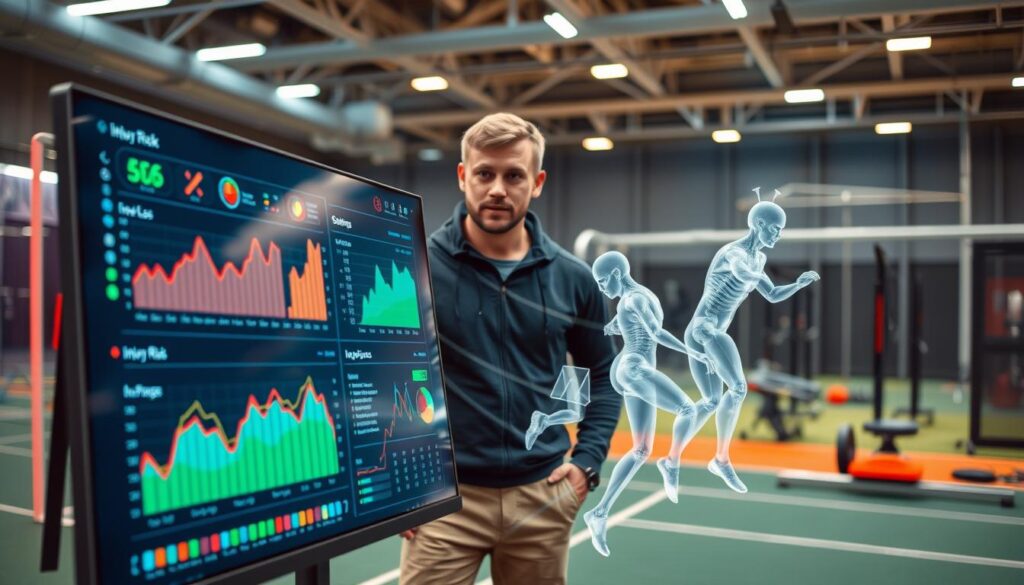
This isn’t fantasy. It’s what happens in high-performance labs every Tuesday. Rugby Australia uses AI to reduce concussion risks. Tennis Australia tracks serve patterns to prevent injuries.
AI looks at how we move and calculates the risks. It shows how small issues can lead to big problems. This changes coaching from fixing problems to preventing them.
So, what’s the bottom line? This is the best way to train athletes. It’s about being great today and healthy tomorrow. AI sports coaching is a win-win for athletes and their bodies.
Personalized Training Program Generation
The AI has watched your every move and analyzed your data. Now, it’s time for the magic to begin. This is where personalized training AI transforms from a spy to an architect.
It uses the data from machine learning and computer vision to create a custom plan for you. This plan is not like a generic PE class. It’s tailored to fit your body’s unique needs.
Your AI plan is like a living document. It adjusts based on how you feel. If you didn’t sleep well, it might make your morning workout easier.
It also gets harder if you’re recovering quickly. This means your workouts will always be challenging but not too hard. Source 2 says this adaptability is a big plus.
This personal touch goes beyond just workouts. Source 3 explains how AI creates plans that include injury prevention and nutrition advice. It doesn’t just tell you to do squats. It calculates the right weight for your tendons and suggests snacks based on your sweat.
The difference between a generic plan and an AI plan is huge. It’s like the difference between a rented tuxedo and a custom-made suit.
| Aspect of Training | Generic, Off-the-Shelf Program | AI-Generated Personalized Plan |
|---|---|---|
| Foundation | Based on population averages and broad goals. | Built on your unique biomechanical, physiological, and performance data. |
| Adaptability | Static. You follow the plan; the plan doesn’t follow you. | Dynamic. Adjusts daily based on sleep, recovery, fatigue, and progress metrics. |
| Injury Management | Reactive. You get hurt, you stop. | Proactive. Identifies risk patterns and modifies training to fortify vulnerabilities. |
| Nutritional Synergy | Separate. “Eat healthy” is the typical, vague advice. | Integrated. Suggests fueling strategies timed to your specific training loads and recovery needs. |
| Long-Term Path | A linear series of workouts toward a fixed goal. | A branching, evolving journey that recalibrates based on continuous feedback. |
The table shows the difference. The old model is one-way. The new model, with personalized training AI, is a dialogue. It listens to you and adjusts.
This means elite athletes can win by being smarter, not just harder. For the rest of us, it means having a plan that fits our unique needs.
The future of training isn’t a generic routine. It’s an AI in your pocket that knows exactly what you can handle. It’s not just personalized. It’s you, optimized.
Virtual Reality Training Environments
Remember the holodeck from Star Trek? It was a dream of training anywhere, against anyone. Now, it’s a key part of top sports training. It’s not just a dream—it’s real, giving athletes a digital edge.
Why run on a boring track when you can race in a digital Olympic stadium? VR lets athletes train in amazing places without limits. A small clinic can now help athletes practice soccer moves or basketball plays.
VR isn’t just about cool graphics. It’s about creating safe, high-pressure training. Want to practice a free throw with the game on the line? Or face a 100mph fastball? VR makes it all possible.
This tech is changing sports by making training accessible to all. A high school athlete in Nebraska can train like an NFL player in Texas. It’s about equal chances for everyone, no matter where they are.
VR is like a super trainer for your mind and body. It mixes physical effort with mental challenges in a safe space. Athletes learn to make quick decisions and improve their skills.
VR isn’t just for sports. It makes physical education fun and engaging. It helps with rehab by making exercises feel like games. Even casual exercisers get excited about virtual workouts.
VR Training Environments are more than gadgets. They change how we prepare for sports. They make training exciting and help athletes overcome fears and boredom.
We’re not just seeing better training. We’re seeing athletes think and decide faster. VR adds a new level to training, making athletes more resilient. It’s a big change in sports technology.
Biometric Integration and Feedback
Forget counting steps. The new frontier in AI sports coaching isn’t about what your body does—it’s about listening to what it says. We’re moving from external mechanics to internal symphonies. Your heart rate, sweat composition, muscle oxygenation, even the quality of your sleep are now data streams, fed in real-time to an AI that acts less like a coach and more like a polygraph for your physiology.
This is where wearables graduate from fitness trackers to medical-grade informants. They provide a continuous whisper of your body’s state, allowing the AI to give feedback that’s profoundly personal. It’s not just, “Your swing was 3 degrees off.” It’s, “Your core temperature is rising too fast for optimal endurance,” or “Your heart rate variability suggests your nervous system is stil fried from yesterday’s session.” The gut feeling of an athlete meets the cold, hard data of a machine, and the result is a biofeedback loop of unprecedented precision.
The practical applications are staggering. Take injury prevention and rehab. Tools like the Zibrio Balance Coach use AI to analyze subtle weight-shifting patterns, critical for rebuilding stability after an ankle sprain or knee surgery. It turns balance from a feeling into a measurable, improvable metric. Similarily, the NordBord provides objective, AI-driven strength data for hamstring rehabilitation, removing guesswork from the recovery process.
But it’s the real-time intervention that feels like science fiction. Imagine your smart sleeve detecting early signs of muscular fatigue or inefficient oxygenation before you feel the burn. The system could cue a hydration alert or even suggest an immediate change in pace to prevent overtraining. This isn’t about working harder; it’s about working smarter, with your body’s own signals as the ultimate guide.
The table below breaks down the key physiological metrics that modern AI sports coaching platforms are now integrating, moving far beyond simple heart rate.
| Biometric Data Stream | What It Tells the AI | Primary Coaching Application |
|---|---|---|
| Heart Rate Variability (HRV) | Stress on the autonomic nervous system, recovery status, and readiness to train. | Preventing overtraining by adjusting daily workout intensity based on recovery. |
| Muscle Oxygenation (SmO2) | How efficiently muscles are using oxygen during activity, indicating local fatigue. | Optimizing interval training and pacing; identifying muscular weak points. |
| Electrodermal Activity (EDA) | Changes in skin conductance, a proxy for sympathetic nervous system arousal (stress/excitement). | Mental performance coaching, managing pre-competition nerves, and focus training. |
| Core Body Temperature | Thermoregulatory strain and risk of heat-related performance decline or illness. | Real-time hydration and cooling strategies for endurance athletes. |
| Sleep Architecture | Time spent in deep (physical recovery) and REM (mental recovery) sleep stages. | Tailoring recovery protocols and correlating sleep quality with next-day performance metrics. |
This integration closes a critical gap. For decades, athletes and coaches had to infer internal states from external performance. Now, the internal state is the performance data. The AI synthesizes these whispers into a clear, actionable narrative. It’s the difference between driving a car by listening to the engine knock and having a full digital dashboard showing oil pressure, coolant temp, and fuel mixture in real-time. One is an art. The other is a precise, personalized science.
The promise of this biometric fusion is a coaching relationship that is almost intimate in its understanding. It respects the body’s limits while strategically pushing its boundaries. In the end, the most powerful AI sports coaching tool might not be the algorithm itself, but its ability to give a voice to the body’s silent, complex song.
Ethical Considerations in AI Coaching
The promise of personalized training AI is bright, thanks to tools like IBM Watson and Catapult Sports wearables. But, there are shadows in the machine. Who gets to own the detailed biomechanical data these systems collect? This data is more than just information; it’s a digital map of our bodies.
Algorithmic bias lurks in the shadows. If a training model is mostly trained on data from one group, its advice can be off. It might tell a runner with a unique gait they’re doing it wrong, even if the algorithm hasn’t seen their body type before.
There’s also the problem of self-fulfilling prophecies. A system that’s 85% accurate might predict an athlete is injury-prone. Does this prediction itself limit their playing time, making the forecast come true?
Another challenge is access. Many educators lack the skills to use these tools, creating a digital gap. The most advanced AI in sports training is useless if the coach can’t understand its insights.
The rules for ethical AI in sports are yet to be written. To win, we need transparency, fair access, and a clear rule: AI is a great helper, but not the boss. The future of sports is smart, and it should also be fair.