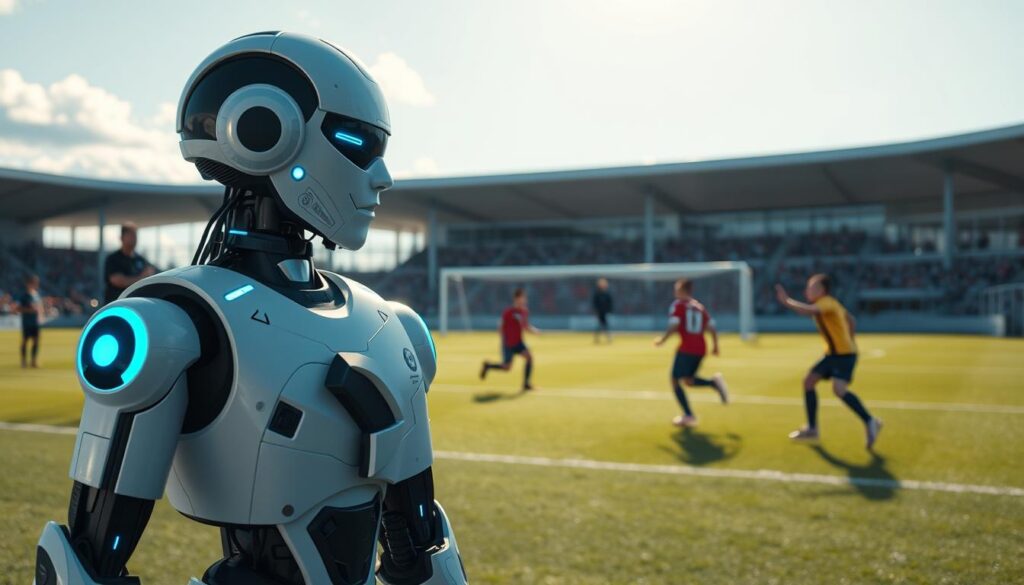
Imagine the heavyweight championship of the world. On one side, a human official sips coffee. On the other, a silent algorithmic judge analyzes pixels instead of the electric ring atmosphere.
After the Oleksandr Usyk vs. Tyson Fury fight, the AI judge agreed with the human officials. But it saw Usyk’s victory as clearer. So, who was right? More importantly, who was fair?
This technology is moving into kids’ sports. We’re giving code the power to make decisions, promising fairness.
But technology doesn’t solve human problems. It just makes them digital. The big questions are fairness, transparency, privacy, and accountability—issues that often intersect with broader conversations around ethics and well-being, much like discussions found in holistic healing and spiritual practices.
This is my exploration into AI’s role in youth sports. Can it really make things fair? Or are we just creating a more efficient, biased referee?
How AI is Used: Refereeing, Coaching, Stats
AI in youth sports is not about replacing humans. It’s about helping them with endless data. Imagine having a super-obsessive assistant coach with perfect memory. It helps in three main areas: refereeing, coaching, and analyzing stats.
In games, AI in refereeing is like a “robot ref.” It’s most seen in sports like tennis and soccer. Hawk-Eye uses cameras to call lines in tennis with amazing accuracy. In soccer, it helps decide if a goal is valid or not.
Off the field, AI becomes a personal coach and health watcher. It uses data from wearables to check if athletes are overworking. This helps prevent injuries and makes training better for each player.
AI also does amazing stats work. It’s like Moneyball but way more advanced. In baseball, it tracks everything from hits to the exact path of a ball. For soccer and basketball, it analyzes team movements and player stats.
| Application Domain | Function | Example Tech/Tool | Impact on Youth Sports |
|---|---|---|---|
| Refereeing & Officiating | Real-time decision support for line calls, offside, and violations. | Hawk-Eye (Tennis), Goal-Line Tech & Semi-Automated Offside (Soccer) | Seeks to eliminate human error in game-critical moments, promoting perceived fairness. |
| Coaching & Player Development | Personalized training, injury prediction, and biomechanical analysis. | Wearable sensors (GPS, accelerometers), Video analysis software | Enables hyper-personalized training, reduces injury risk, and optimizes athletic performance. |
| Scouting & Performance Analytics | Advanced statistical analysis and talent identification via data. | Statcast (MLB), aiScout, Team performance dashboards | Unlocks deeper game insights and provides new pathways for talent discovery beyond traditional networks. |
The main goal of AI in sports is pure objectivity. It’s about using data over feelings. But, is the data really fair? This depends on what we teach the AI and who made it. As we look into the future of AI in sports, this question is key.
Where Bias Can Enter
Bias is not hidden in AI; it’s welcomed with open arms. It comes through the training data we provide. We aim to create systems that find truth, but their views are shaped by our data. It’s like raising a digital official on a biased diet.
This is the essence of algorithmic bias. It’s an error built into the system’s logic.
AI isn’t smart on its own. It reflects the patterns and biases in its training data. If the data is biased, so will the AI’s judgments. For example, if it’s trained on data from mostly male athletes, it might not value diverse talents.
- The Gender & Identity Gap: AI models trained mostly on male athletes can fail female or non-binary athletes. It’s like using a ruler for one sport on another.
- The Height Hurdle: AI judges in gymnastics subtly penalize taller athletes. This is a bias the algorithm learned, even though it shouldn’t have.
- The Color Barrier: Some AI systems struggle with athletes with darker skin. Here, bias affects not just society but also the AI’s perception.
There’s also the “black box” problem. Many AI models are so complex, even their creators can’t fully understand them. So, when a decision seems wrong, we’re left guessing. Was it a glitch or a hidden algorithmic bias?
This makes fixing bias a huge challenge.
The irony is deep. We use technology to avoid human mistakes, but we end up with a biased AI. The fight for fairness begins by recognizing AI’s limitations. It’s a reflection of our past, both good and bad.
Real Match Examples
Theoretical debates about algorithmic bias are one thing. Watching an sports AI judge dissect a heavyweight title fight is another. Let’s leave the clean room of theory for the messy, adrenaline-fueled reality of competition. Three recent cases show us exactly where the rubber meets the road—or the glove meets the face.
First, the headline act: the undisputed heavyweight championship between Oleksandr Usyk and Tyson Fury. An algorithmic judge was run as a high-profile beta test alongside the human officials. The result? The AI saw a wildly different fight. Its scorecard didn’t just tweak a round or two; it presented an alternate reality of the bout. This begs the uncomfortable question: was the machine seeing more detail in footwork and punch placement, or was it just seeing differently—and perhaps wrongly?
Then, there’s the controlled chaos of the X Games. In snowboard halfpipe, sports AI systems now unofficially judge routines via video capture. They’re not deciding medals yet. They’re the quiet student in the back of the room, meticulously logging every rotation, grab, and amplitude. It’s a training ground. The AI is learning the language of style from the best in the world, but the final translation into a score is a human task.
The most telling case study comes from the precision-obsessed world of artistic gymnastics. At the 2023 World Championships, officials used Fujitsu’s Judging Support System (JSS). This isn’t a robot replacement. As X Games CEO Jeremy Bloom aptly noted, it gives judges “superpowers.” The system uses 3D sensors to spit out hyper-accurate data on joint angles and body positions in real-time.
Here’s the revolutionary part. Coaches can now challenge a score and request an AI review. It’s instant replay with a PhD in biomechanics. Think of it as VAR for the floor exercise. This creates a fascinating dynamic: the human judge’s subjective call is now backed by an immutable digital fact-check. The authority shifts, but the human holds the final scorecard.
So, what do these examples tell us? For now, the sports AI is the nerdy sidekick with the clipboard, whispering numbers to the human who makes the dramatic call. It’s a cautious, supportive role. But every sidekick in history eventually gets their own movie. The question isn’t if the technology works. It’s how long we’ll be comfortable with the human having the last word.
Athlete and Coach Voices
The “Project Red Card” lawsuit shook the sports world. But its impact is strongest in youth leagues, where data rights are unclear. Over 800 footballers sued for using their data without permission. This shows that even pros can be exploited, and what about young athletes?
Young athletes’ data is collected and possibly sold. This raises big questions about privacy and power. Getting consent from young players is often tricky, as they might feel pressured.
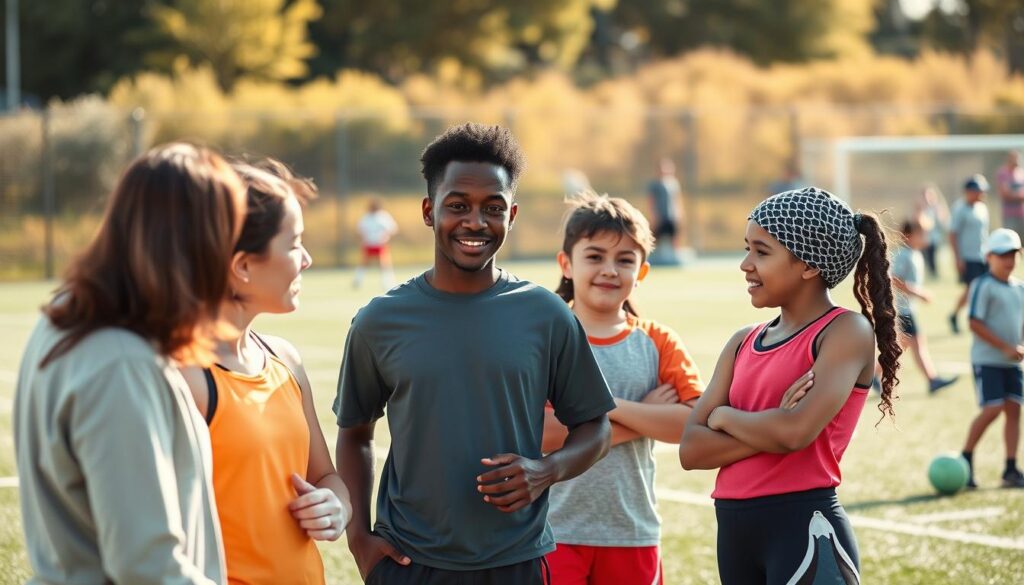
Coaches are skeptical about using data to judge players. They believe in the “eye test,” which can’t be measured by technology. They think using data alone is unfair and misses the human side of sports.
Imagine a player getting a low injury risk score from AI. But a coach might see a player’s true talent and heart. Decisions based only on data can be unfair and might miss out on future stars.
So, what is digital fairness in sports? It’s about being open about who owns data and where it goes. It’s about giving everyone fair access to data insights, not just the top teams. It’s about making sure young athletes benefit from their data, not just tech companies.
Potential Solutions
The future isn’t just about choosing between technology and human effort. It’s about creating a fair system that uses both. We aim to build a system that seeks digital fairness. But how do we achieve this?
We need to shift from a passive approach to an active one. Imagine training an AI like a rookie official. It needs clear rules, diverse experiences, and constant feedback.
There’s a plan to tackle algorithmic bias. It involves several steps:
- Ruthless Audits: We must regularly check these systems for biases. Does the AI struggle with certain body types? Does it undervalue certain play styles? Audits across different groups are essential.
- Diverse Data Diets: An AI trained only on elite teams has a narrow view. Its data must reflect the diversity of all youth sports.
- Transparency Tools: AI should explain its decisions. Tools like LIME or SHAP help show why a call was made. This builds trust and digital fairness.
- Sport-Specific Ethics: Each sport needs its own rules. Soccer focuses on intent, while basketball looks at contact. We must define what AI can decide and what humans must judge.
- The Human Safety Net: This is key. The “human-in-the-loop” model ensures AI assists but doesn’t override. Humans make the final call on intent and training plans.
This approach combines AI’s strengths with human judgment. It ensures technology helps, not hinders. It recognizes that some aspects of the game can’t be measured.
The key to overcoming algorithmic bias is accountability. It’s about using technology wisely. By combining these solutions, we can create a future where technology enhances the game. This is a goal worth striving for.
Next-Gen AI and Personalization
Today’s AI is like a referee, but tomorrow’s will be a coach with deep knowledge of each athlete. We’re moving from simple reviews to deep, personal understanding. The next sports AI will not just judge the game but understand and improve each athlete.
It’s a shift from big to small. Current analytics might spot a team’s weakness. But next-gen AI will find the exact moment a player’s injury risk spikes. It’s like going from a general weather forecast to a detailed forecast for your exact location.
The data is getting very personal. We’re talking about sleep patterns, muscle activity, and stress levels. An AI combining this data will create a unique routine for each athlete. It’s predictive analytics that goes from warning to guardian angel.
On the tactical side, elite insights are becoming more accessible. Clubs like Liverpool use tools like TacticAI to analyze set-piece scenarios. Now, imagine that power for a high school basketball coach. It could give an underfunded team an edge.
The chance for fair talent identification is huge. An AI can spot talent that a human might miss. It could find a future star goalkeeper based on their reaction time and decision-making.
But there’s a catch: this could start an AI arms race. The most advanced silicon coaches will be expensive. Will they be available to all schools, or just the wealthy ones? The gap between those with and without access to AI could grow.
The question now is, “Can we ensure access to fair AI?” The technology promises a future where every athlete gets personalized training. But we must make sure this future is available to all, not just the privileged few.
The real challenge is making personalization inclusive. That’s the real championship game for the next wave of sports AI.
Debate: Tech vs. Human
Sports have always been about humans, but now AI is trying to change the game. The main issue with AI in refereeing isn’t about technology. It’s a battle between logic and human intuition.
The algorithm has a strong argument. It never gets tired and doesn’t favor anyone. It promises fairness and accuracy, which sounds great.
But sports are more than just numbers. They’re about emotions and flair. How do you measure the excitement of a soccer goal or the beauty of a gymnast’s routine?
Researcher Willem Standaert points out AI’s strengths and weaknesses. It’s great at judging technical skills but struggles with creativity and emotion.
Standaert also highlights a paradox. AI might reduce some biases but introduce new ones. For example, it might favor shorter gymnasts based on past winners.
So, should we replace referees with machines? Not yet. A mix of human and AI is a better idea. Humans bring intuition, while AI ensures fairness.
X Games CEO Jeremy Bloom agrees. He sees AI as a tool to help judges, not replace them. It’s about making calls more accurate, not taking away from the human touch.
The future should blend human judgment with AI’s precision. Let AI handle the easy questions and let humans deal with the tough ones.
The goal of AI in refereeing is to enhance human judgment, not replace it. It’s about making the game fairer, not less human.
The real debate is not tech versus human. It’s about how tech can support the human side of sports. AI makes the game fair, but humans make it meaningful.
Conclusion
So, where does that leave us? The quest for digital fairness in youth sports isn’t a simple win or lose. It’s a long-term effort to fix our own biases. AI systems like Hawk-Eye and VAR promise perfect calls. But they reflect our world’s flaws.
The real challenge is to fight algorithmic bias before it’s too late. We need diverse teams, clear algorithms, and regular checks. Future research should focus on ethics, for all sports, and global standards. These steps are essential for fair sports governance.
The aim isn’t a game run by robots. It’s about fairness. True digital fairness uses AI to help us see better. It keeps humans at the heart, making decisions for kids’ safety and happiness.
Can AI make it fair? Only if we’re smart enough to create it that way.