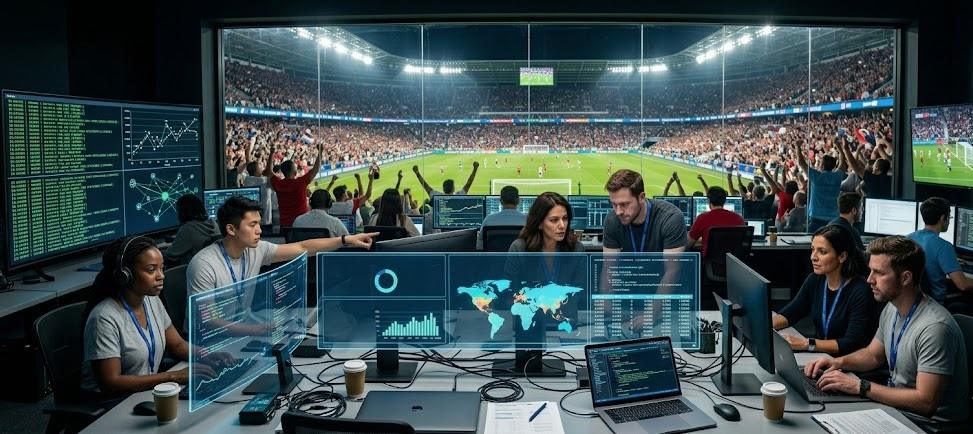
The broadcasting booth is getting a high-tech upgrade. Artificial intelligence is now stepping into the role of game narrator. This is changing how fans experience live events.
These AI sports commentators are advanced software systems. They analyze real-time statistics, player movements, and key moments during a match. The technology then turns this data into natural-sounding commentary.
This change is a big shift from traditional human experts. While a person relies on experience and instinct, an AI play-by-play system uses algorithms and instant data processing. It can break down complex plays with precision, giving insights that might be missed by humans.
Companies like IBM have already shown this at major tennis tournaments. The promise is huge: consistent, analytical, and always-on narration. But, a big question remains. Will audiences connect with and trust a digital voice calling the action?
This article will dive into the mechanics of this innovation. We’ll look at its strengths, its possible downsides, and the ethical issues it raises. The aim is to understand not just how it works, but if it will win over the fans.
Pipeline: data ingest → event detect → script → TTS → mix
Creating AI sports calls involves a five-step process. It turns raw game data into exciting audio stories. This process happens fast, often in real-time, to give fans the play-by-play they love.
Imagine a sports narration assembly line. Each step adds intelligence and polish. It turns numbers and events into stories. The whole sequence—data ingest, event detection, scripting, text-to-speech, and mixing—must work together perfectly.
The table below shows the five main stages of the AI commentary pipeline. It explains what goes in, what happens, and what comes out at each step.
| Pipeline Stage | Primary Input | Core Action | Output |
|---|---|---|---|
| 1. Data Ingest | Live stats feeds, player tracking data, official game events | Aggregating and structuring real-time information from multiple sources | A unified, machine-readable data stream |
| 2. Event Detection | Structured data stream | Algorithmic identification of key moments (goals, turnovers, spectacular plays) | Flagged “highlight events” prioritized for commentary |
| 3. Scripting (NLG) | Flagged events with contextual data (score, time, player history) | Natural Language Generation crafts coherent, context-aware narrative sentences | A written commentary script |
| 4. Text-to-Speech (TTS) | Written commentary script | Voice synthesis engine converts text into natural-sounding spoken audio | Raw audio file of the AI commentator’s speech |
| 5. Audio Mix | Raw TTS audio and live broadcast sound (crowd, effects) | Balancing and integrating the AI voice seamlessly into the overall broadcast audio | Final mixed audio feed ready for distribution |
The journey begins with data ingest. AI systems don’t watch video like humans. They consume structured data feeds. This includes real-time stats, player positions, and game event logs.
Next, event detection algorithms scan this data. They look for patterns that show important moments. A sudden spike in ball speed or a player’s location inside the penalty area triggers the system.
Once an event is flagged, the scripting stage takes over. Here, Natural Language Generation (NLG) software acts as the AI’s writer. It builds a mini-narrative, using context like the player’s name and the current score.
The written script then gets its voice in the text-to-speech phase. This is where the magic of audible AI commentary happens. Modern TTS engines can generate speech with the right intonation and emotional inflection. The choice of voice is a key branding decision for networks.
The final step is the broadcast mix. The clean TTS audio is mixed with stadium sound, crowd noise, and broadcast effects. This mixing process is key for authenticity. It makes the AI voice sound natural, not detached.
IBM’s watsonx platform at Wimbledon and the US Open is a great example. It ingests match data, detects key points, generates scripts, and produces spoken commentary. This shows how the pipeline can automate engaging content creation. For more on AI in media, exploring beyond sports reveals the same principles of data-driven narrative creation.
Strengths: multilingual, lower-tier coverage, context nuggets
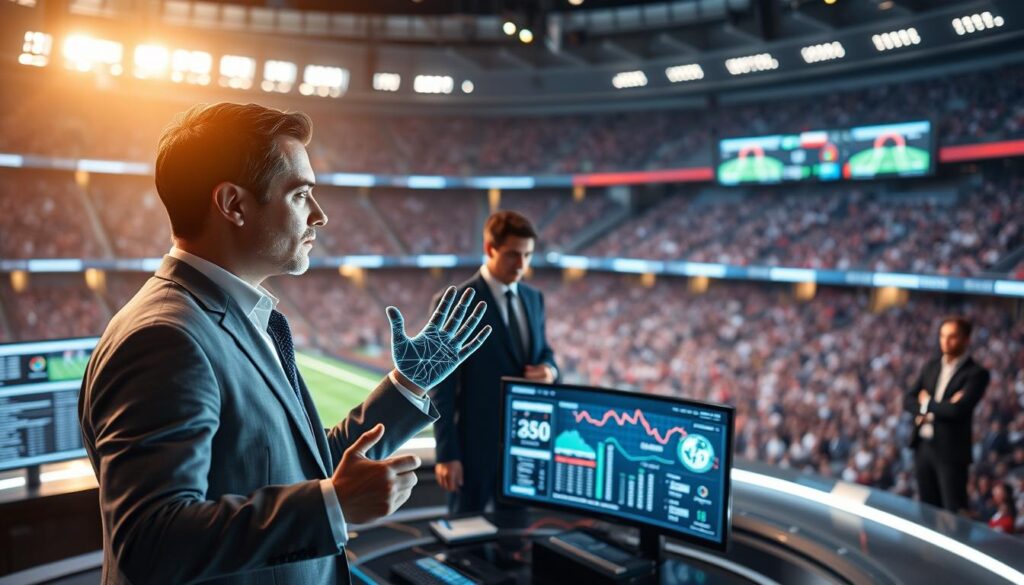
AI-driven commentary brings three key strengths to the broadcast booth. It offers global reach, economic scalability, and data-rich storytelling. These benefits are changing how we access sports and understand them.
First, AI commentators are great at instant multilingual narration. They can turn one data feed into live commentary in dozens of languages at once. This breaks down language barriers, letting fans worldwide enjoy events in their own language.
The second major strength is scalable, cost-effective coverage. It’s hard to afford human commentators for every minor league game or emerging sport. AI solves this problem by providing professional audio for these events. This opens up new chances for fan engagement and growth in underserved markets.
AI’s biggest strength is its ability to add data-driven context nuggets to the commentary. While humans might mention a key stat, AI can include real-time player metrics and predictions. This makes the commentary more layered and insightful.
This is all thanks to natural language processing (NLP) summarization. This tech analyzes lots of data and turns it into clear, engaging summaries. For example, IBM’s “Catch Me Up” feature at Wimbledon uses nlp summarization to give fans short stories about their favorite players or key moments.
| Feature | AI Commentator | Human Commentator |
|---|---|---|
| Language Coverage | Can generate near-instant, simultaneous commentary in multiple languages from one data source. | Typically limited to one or two languages per broadcaster, requiring separate talent for each. |
| Cost & Scalability for Niche Events | Highly scalable; operating costs are largely fixed, making coverage of lower-tier leagues economically feasible. | Cost-prohibitive for many small events due to travel, fees, and production costs for a full team. |
| Data Integration & Context | Excels at injecting real-time statistics, historical parallels, and predictive analytics directly into the narrative flow. | Relies on memory and preparation; can deliver prepared stats but may miss real-time data correlations. |
| Narrative Flexibility & Emotion | Follows a logical, data-informed script; can lack genuine emotional reaction and spontaneous storytelling. | Superior at conveying excitement, drama, and crafting compelling, adaptive stories based on feel. |
AI commentary is a powerful tool. It can globalize sports, democratize coverage, and deepen the fan experience. It’s not a replacement but a great addition to the traditional sports media landscape.
Trust & fairness: hallucinations, brand bias, disclosure labels, audit logs
Before fans can embrace AI voices, the industry must tackle critical issues of reliability and fairness head-on. Trust is the single biggest hurdle. An audience will switch off if they suspect the commentary is inaccurate or biased.
Two primary pitfalls threaten this trust. First, AI systems can hallucinate. This means they might generate a plausible-sounding but completely fabricated fact, like crediting a player with a goal they didn’t score.
Second, there’s a risk of inherent brand bias. If an AI model is trained mostly on data from one major league or a specific team’s broadcasts, its commentary could subtly favor that entity. This undermines the neutrality fans expect.
- Hallucinations: The AI invents incorrect statistics or narrative details.
- Brand Bias: Skewed training data leads to non-neutral, unfair commentary.
The solution lies in a robust framework of transparency. You cannot ask for blind trust. Instead, you must build verifiable credibility through clear processes and disclosures.
Key transparency measures include:
- Disclosure Labels: A clear, on-screen indicator informing viewers that the commentary is AI-assisted or AI-generated. This manages expectations from the start.
- Detailed Audit Logs: Maintaining a complete record of the AI’s decision-making process. This allows developers and regulators to review which data points the system used and how it arrived at its spoken analysis.
Ultimately, the entire system’s credibility is built on one foundation: the quality of its incoming data. Accurate, real-time live stats are non-negotiable. Garbage in, garbage out. If the data feed from the game is flawed, even the most advanced AI will produce faulty commentary.
This connects directly back to the first stage of the pipeline—data ingest. Building trust isn’t just about the AI’s speech. It’s about proving the integrity of the live stats and event data it consumes. Audit logs should verify this data’s source and timestamp, creating a chain of custody for every fact stated.
By openly addressing hallucinations, mitigating bias, and championing transparency, broadcasters can construct a trust framework. This turns a skeptical audience into an engaged one.
Human–AI workflow in the booth; kill-switches
The future of sports broadcasting is exciting. It’s not about a silent booth run by machines. Instead, it’s about a team effort where AI helps human experts.
This team model sees AI as a real-time helper. It gives the commentator important data right when they need it. The human commentator then uses this info to create engaging stories.
The AI provides stats, historical context, and story ideas. The human commentator then adds emotion and cultural understanding. This mix makes the broadcast richer and more authentic.
Fans get to see deeper insights. But they also keep the authentic voice they love.
The Division of Labor: A Practical Breakdown
Let’s look at how this team works. The AI quickly processes data and suggests ideas. The human commentator then decides what to say and how to say it.
| Role | Primary Responsibilities | Key Contribution |
|---|---|---|
| AI Assistant (Super-Producer) | Real-time data analysis, stat retrieval, trend spotting, generating context “nuggets,” multilingual translation of on-field audio. | Depth, speed, and scale of information. |
| Human Commentator | Curating AI suggestions, delivering final commentary, providing emotional tone, building storylines, reacting to spontaneous events, engaging with co-commentators. | Trust, authenticity, and human connection. |
| Producer/Director | Monitoring AI output, managing the broadcast flow, executing kill-switches, making final editorial decisions. | Oversight, safety, and broadcast quality control. |
The Non-Negotiable Safety Net: Kill-Switches
Trust in this system comes from human control. Kill-switches are key. They let humans stop AI if it makes a mistake.
If the AI suggests something wrong, a human can stop it instantly. This is vital for live broadcasts.
It keeps the broadcast true to its word and protects the brand from AI mistakes.
Winning the Race Against Time: Managing Latency Budgets
The AI’s insights must arrive just in time. This is the challenge of latency budgets.
In live sports, a latency budget is the time between an event and the commentator speaking about it. If it’s too long, the moment is lost.
Engineers and producers must manage these latency budgets carefully. They optimize data flow and AI models. The goal is for AI to contribute smoothly and on time.
The perfect human-AI booth balances speed, data, and human touch. With clear roles, kill-switches, and tight latency, broadcasts become more engaging and trustworthy.
DIY: build a non-commercial highlight VO safely
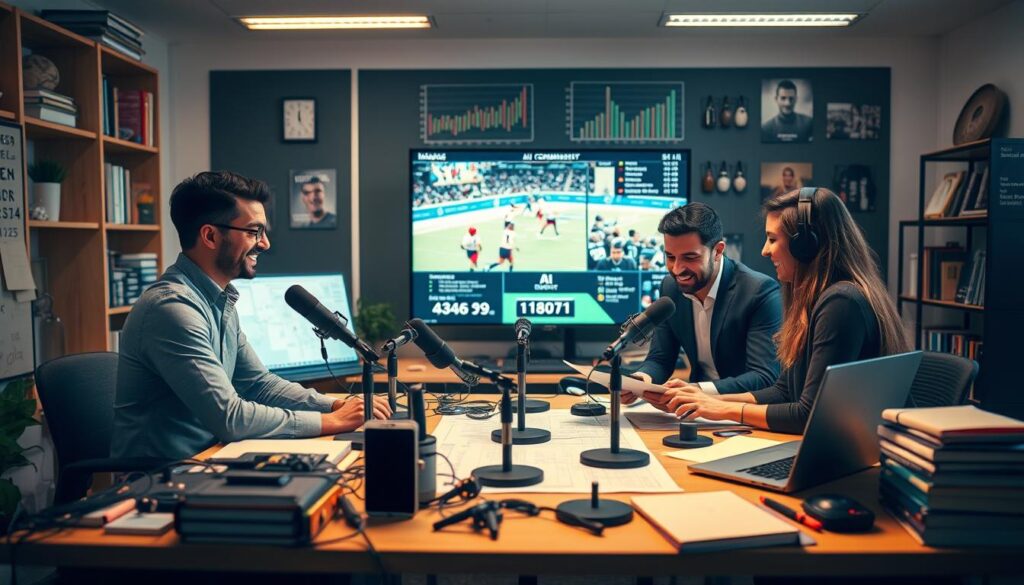
Starting a journey to create a safe, non-commercial AI commentator is exciting. It involves understanding tools and ethical limits. For fans and creators, it’s a great way to learn about the tech behind pro broadcasts.
You can make simple automated voice-overs for your own highlight reels. The process is similar to pro systems but uses easier-to-find parts.
First, you need game data. Getting this data safely is key. Use official league APIs, public stats, or log it yourself. Stay away from unofficial sites to avoid legal trouble.
Next, simple event detection is possible with open-source tools. OpenCV can spot important moments like goals or tackles in videos.
Script generation is where you must watch out for bias. The language model or template might have biases. It could favor certain playing styles without you knowing.
For speech, there are many ethical text-to-speech APIs. Google, Amazon, and Microsoft offer natural voices. Always pick a voice that fits the sport and check the provider’s ethical use policies.
The last step is mixing the audio with your video. Free audio editing software makes this easy for a fan project.
Transparency is non-negotiable. You must clearly say your content is AI-generated. A “AI Voice Commentary” watermark or a disclaimer in the video description keeps trust. It stops misleading your audience.
This project is for learning and personal use only. Using it for fan projects or analysis is okay. But, using it for money without proper licenses is not.
The table below summarizes the key considerations for a responsible DIY build:
| Aspect | DIY Approach | Why It Matters |
|---|---|---|
| Data Sourcing | Use official APIs, public stats, or self-collected data. | Ensures legal compliance and data accuracy. Avoids copyright infringement. |
| Model & Script Selection | Audit open-source models for inherent bias. Use simple templates you control. | Prevents the AI from introducing unfair narrative or hidden preferences into your commentary. |
| Output Labeling | Always include a visual/verbal “AI-Generated” disclaimer. | Builds audience trust and meets emerging ethical standards for synthetic media. |
| Usage Scope | Strictly non-commercial: fan edits, personal archives, educational demos. | Keeps the project ethical and legal. It’s a learning tool, not a product. |
Building your own system teaches you about AI commentary’s good and bad sides. You see how bias can sneak in and why being open is important.
This hands-on learning makes you understand tech’s strengths and weaknesses. It turns you from a passive viewer into an informed creator.
Jobs emerging: prompt ops, QA, audio eng
The use of AI sports commentators is creating new jobs, not replacing old ones. This change turns job loss fears into stories of job growth. The technology is leading to roles that focus on quality, creativity, and technical details.
These new jobs make sure AI commentary is accurate and engaging. They ensure it fits well into the live sports experience. Let’s look at the three main jobs that are emerging.
Prompt Operations Specialist: The AI Editor
A Prompt Ops specialist is like an editor for an AI’s voice. They write the instructions that guide the AI’s speech. It’s more than just typing commands.
They need to know a lot about sports and how to keep the audience interested. They decide when to add excitement, explain rules, or share stats. Their work shapes the AI’s voice and personality.
AI Commentary QA Tester: The Guardian of Quality
QA testers for AI output have a big job. They check the AI’s commentary before it airs. They listen for mistakes the AI might make.
They catch errors like wrong scores or player names. They also watch for tone, bias, or missing context. A good tester is passionate about sports and has a keen eye for detail.
AI Audio Integration Engineer: The Sonic Sculptor
This engineer mixes AI-generated voice with live sounds. They blend the AI’s voice with stadium noise, music, and sound effects. Their skill makes the AI voice sound natural.
They adjust the timing, pitch, and reverb to match the arena’s sound. Their work ensures the commentary feels connected to the game. They create an immersive audio experience.
As AlphaPlay AI notes, AI systems need more humans to manage and check them. This trend is adding a new layer to the production workforce.
| Emerging Role | Core Function | Key Skills Required |
|---|---|---|
| Prompt Operations Specialist | Crafts & optimizes narrative instructions for the AI | Sports knowledge, creative writing, linguistic precision |
| AI Commentary QA Tester | Audits output for accuracy, bias, and appropriateness | Analytical listening, detail orientation, sports rules expertise |
| AI Audio Integration Engineer | Blends synthetic voice with live audio for natural sound | Audio engineering, sound design, real-time mixing |
The story is changing from AI replacing humans to AI working with humans. These new careers show that AI is a powerful tool that needs skilled human operators. For more on how AI is changing sports, check out our introduction to AI in sports. The future of sports media is about humans and AI working together to tell better stories.
Ethics corner and fan surveys
The rise of AI sports commentators raises big ethical questions. Who gets to own the data and insights these systems create? Could biases in algorithms affect what we hear about the game?
Being open and clear is key to winning fan trust. Surveys show that younger fans like AI-generated content a lot. It’s important for broadcasters to keep checking in with viewers.
It’s not just about the tech; it’s about how it fits into our world. We want AI to help, not replace us. New jobs in AI management and oversight are needed, ensuring a smooth transition for everyone.
As talks about AI ethics in sports show, we need to be careful. Tools that track player movements need strict rules. Keeping the conversation with fans and staying vigilant ensures AI enhances the game’s story without losing its heart.