Forget the ivory tower. The real game isn’t played by guys in suits yelling at draft boards. It’s played by anyone with the curiosity to see a sport’s beautiful chaos as a solvable puzzle.
Think of it as building a mental muscle to complement an athletic one. Take Colleen Fotsch. A national champion swimmer and CrossFit Games athlete. She pivoted into data engineering because the analytical rigor to shave milliseconds off a swim time? It’s the same grind as optimizing a data pipeline.
That’s the mindset. This guide is your secret playbook, distilled from the open-source trenches. It’s the kind of wisdom you find in repositories like Edd Webster’s football_analytics bible.
We’re not just learning to crunch numbers. We’re learning to see the story they tell. Let’s get started.
Essential Math and Statistics Skills
Statistics might seem daunting, but they’re everywhere in sports. From batting averages to expected goals, they tell stories. You don’t need to be a math genius. Just learn to speak data.
Learning data analysis is like mastering a new language. You already know the basics. For example, understanding averages and standard deviations is key. And knowing that a .300 hitter doesn’t always get a hit every 10 times at bat is important. You’re already on your way.
Now, let’s talk about the tools that make it all easier. Libraries like pandas help organize data. NumPy makes quick work of calculations. And Scikit-learn builds models that spot patterns you can’t see.
Your role is to interpret the data, not just crunch numbers. For instance, a model might show that time of possession is linked to winning. Your job is to figure out why. Is it about controlling the game, wearing down defenses, or limiting opponents?
This shift in thinking is what makes sports data analysis so powerful. It turns you from a number-cruncher into a storyteller. You’re not just looking for data. You’re uncovering the story behind the numbers—the why behind the win, the how behind the highlight.
So, let go of your math fears. The numbers are just part of a bigger story. Your job is to understand their roles and guide the action. That’s a class worth taking.
Popular Sports Analytics Software
While pro teams might spend millions on special systems, you can get similar tools for free. The secret lies in the open-source coding community. This is where the real innovation happens.
Think of it this way: proprietary software is like a luxury car with a sealed hood. Open-source tools are like a customizable kit car with blueprints. You can see how it works, change it, and make it your own.
The Python ecosystem is where the action is. It’s the lingua franca of data science, including sports analytics. Libraries like statsbombpy give you access to rich event data, once only for elite analysts.
With soccerdata, you can get info from FBref and WhoScored without any paywalls. Then mplsoccer turns that data into visualizations that would impress any sports network.
These aren’t just tools—they’re your ticket to the conversation. Learning them is like learning the playbook of modern sports analysis.
| Software/Library | Primary Language | Best For | Key Feature |
|---|---|---|---|
| statsbombpy | Python | Event Data Analysis | Direct access to StatsBomb’s rich event data |
| soccerdata | Python | Data Collection | Scrapes multiple public football databases |
| mplsoccer | Python | Visualization | Creates stadium-style plots and advanced charts |
| worldfootballR | R | Comprehensive Stats | Pulls data from FBref, Transfermarkt, and more |
| ggsoccer | R | Soccer Visualization | Extends ggplot2 for soccer-specific plots |
In the R corner, packages offer similar powers for the statistically inclined. worldfootballR pulls stats from various sources into one format. The ggsoccer package extends R’s ggplot2 system for soccer plots.
Here’s the beautiful part: these tools work together. You can pull data with one library, analyze it with another, and visualize it with a third. The whole workflow happens in your coding environment.
Start with one library that matches your skill level. Get comfortable with it. Then, expand your toolkit. Soon, you’ll be building analyses that impress front offices.
The barrier to entry has never been lower. The software is free. Tutorials are plentiful. The community is welcoming. What’s stopping you from joining the analytics revolution?
Free Data Sources and Databases
Let’s debunk a myth: you don’t need to spend a lot to do sports analytics. Even though pro teams might spend millions, there’s plenty of free, quality data for student sports analytics fans. Your first task? Explore these free resources.
Sports data comes in three types: event, tracking, and aggregated. Each has its own use, and knowing them all is key to deep analysis.
For event data, StatsBomb Open Data is top-notch. It gives you detailed insights into every game. It’s perfect for creating your first analysis projects.
For expected goals (xG), Understat is the go-to. It turns every scoring chance into a probability. This makes “he should have scored” into actual numbers.
Tracking data is for the advanced. It shows how players move on the field. Metrica Sports offers free samples. Download them to see player movements in detail.
Aggregated season stats give you the big picture. FBref is like a soccer stats Wikipedia. It’s free and has everything from striker comparisons to team strength ratings.
| Data Type | Primary Source | Best For | Skill Level |
|---|---|---|---|
| Event Data | StatsBomb Open Data | Play-by-play analysis, tactical patterns | Beginner to Intermediate |
| Advanced Metrics | Understat | Expected goals (xG), chance quality | Intermediate |
| Tracking Data | Metrica Sports samples | Movement analysis, spatial models | Advanced |
| Aggregated Stats | FBref, Elo ratings | Season comparisons, player scouting | Beginner |
Where to begin? Choose a source that interests you. Download a dataset. Open it in a spreadsheet. Look for a simple story, like which player created the most chances in a game.
These resources let you tackle real problems today. No hypotheticals or fake data. Your work can be as valid as any consultant’s.
Remember, the data is just the start. Your value is in asking the right questions. Why did a team dominate but lose? How does a player’s position affect their scoring chances? The answers are in these free databases, waiting for you.
This isn’t about having all the answers at once. It’s about learning to ask better questions. With these free sources, you’re not just practicing—you’re adding to the real conversation around sports. That’s the true power of student sports analytics.
Creating Your First Analysis Project
Reading about analytics is like watching cooking shows without ever touching a spatula. The recipes look fantastic, but you’ll never know if you can actually cook until you fire up the stove. Your first analysis project is that moment—when theory meets practice, and you discover whether you’re a data chef or just a spectator.
Start simple. I cannot emphasize this enough. Your inaugural project shouldn’t be an attempt to rebuild Manchester City’s entire recruitment model. That’s the analytics equivalent of trying to bake a soufflé on your first day in the kitchen. You’ll likely end up with a mess and a strong desire to order takeout.
Instead, follow a classic, battle-tested data workflow. Think of it as your basic mise en place—getting all your ingredients prepped before the real cooking begins.
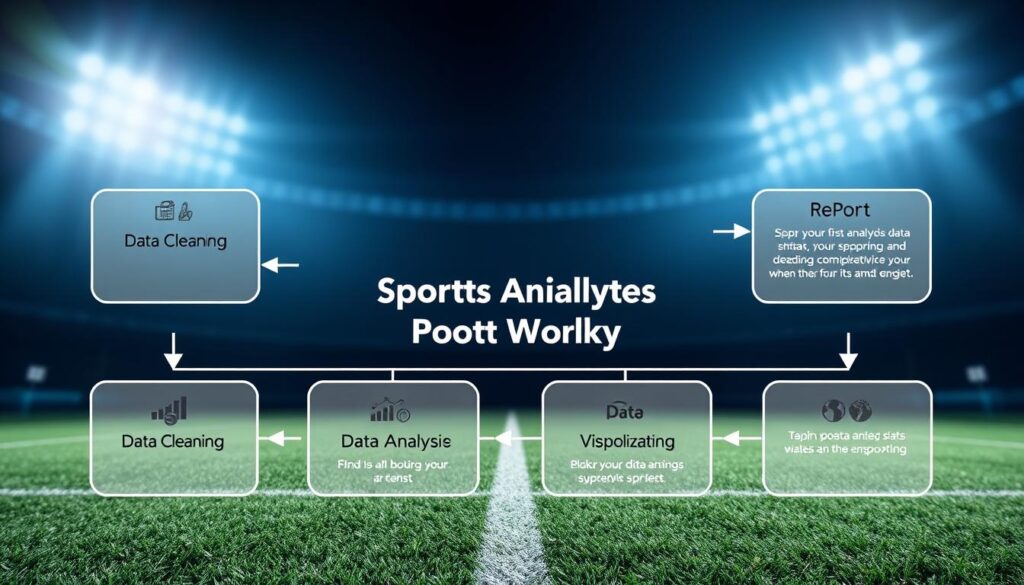
- Acquire the data. This is your shopping trip. For sports analytics, fantastic free data lives on sites like FBref. Your first mission? Use web scraping to pull down a single season’s worth of stats for a league that interests you. Don’t get greedy; one season is plenty.
- Clean and structure it. Hello, pandas DataFrames. Raw data is messy—like produce straight from the farm. You need to wash it, chop it, and organize it. This data cleaning phase involves handling missing values, standardizing formats, and creating a tidy dataset you can actually work with.
- Ask a single, clear question. This is your recipe. It must be specific. “Which players in La Liga had the highest xG overperformance last season?” is perfect. “How does a team’s pass network change when they’re leading versus when they’re trailing?” is another winner. One question. One answer to find.
- Analyze, visualize, and write up your findings. This is the plating. Use your stats skills to crunch the numbers. Create a clear chart or two. Then, document everything in a simple report. What did you ask? What did you do? What did you find? Why might it matter?
This isn’t about winning a Nobel Prize. It’s about completing the cycle. It’s about going from a question to an answer and having something tangible to show for it. That tangible thing is incredibly powerful.
Where do you find examples of this exact path? GitHub is your new best friend. The platform is overflowing with Jupyter notebooks where other enthusiasts have documented their entire analysis project from start to finish. Find one that tackles a question similar to yours. Replicate it step-by-step. Then, once you’ve got it running, tweak one variable. Change the league. Look at a different metric.
You’re not cheating; you’re learning by doing. This iterative approach—replicate, then innovate—is how you build confidence and skill. Before you know it, you’ll be moving from basic xG models to mapping complex passing networks, all because you started with a simple, complete workflow.
Understanding Key Performance Metrics
The modern soccer analyst speaks a different language. It’s not just about goals and assists. Today, we understand the game through new metrics that show the why behind the what.
When the Football Association gives fans real-time analytics, they’re not just counting shots. They’re telling the story of each opportunity. This is where we move from casual observation to genuine analysis.
Let’s decode this new language, starting with the metric that changed everything. Expected Goals (xG) is soccer’s probability calculator. It looks at shot quality by analyzing distance, angle, and more. A tap-in from six yards might have an xG of 0.8. A 30-yard screamer might be 0.05.
The beauty of xG? It separates skill from luck. A striker who scores 10 goals from chances worth 15 xG is underperforming. One who scores 10 from chances worth 7 xG is either brilliant or ridiculously fortunate. Your job is to figure out which.
Then there’s Expected Assists (xA), the creative counterpart. This measures the quality of a pass that leads to a shot. A simple square ball 25 yards out has a low xA. A through-ball to a striker running in behind has a high xA. It rewards vision and execution, not just the final touch.
But soccer isn’t just about attacking. Enter PPDA (Passes Per Defensive Action), the metric that quantifies pressing intensity. It counts how many passes the opposing team completes before your team makes a defensive action. A low PPDA (under 10) means you’re pressing aggressively. A high PPDA (over 15) suggests you’re sitting back.
These metrics interact in fascinating ways. A team with low PPDA might force turnovers in dangerous areas, creating high-xG chances. A creative midfielder with high xA might thrive in such a system. Understanding these relationships is where analysis becomes insight.
| Metric | What It Measures | Key Insight Provided | Common Range |
|---|---|---|---|
| Expected Goals (xG) | Shot quality based on historical probability | Separates finishing skill from luck; identifies over/under performers | 0.0 (impossible) to 1.0 (certain goal) |
| Expected Assists (xA) | Quality of passes leading to shots | Rewards creative passing beyond final assist; measures chance creation | 0.0 to ~0.8 per key pass |
| PPDA | Passes allowed per defensive action | Quantifies pressing intensity; reveals defensive strategy | 5-25 (lower = more aggressive press) |
| Goals minus xG | Difference between actual and expected goals | Pure finishing performance; identifies hot streaks vs. regression | -0.5 to +0.5 per game typical |
| Shot Creating Actions | Actions directly leading to shots | Total offensive involvement beyond goals/assists | 2-8 per game for active players |
Here’s the key point: no single metric tells the whole story. xG doesn’t account for goalkeeper quality. PPDA doesn’t consider tactical fouling. Expected Assists can’t measure the intangible—that moment of genius that defies historical data. These are tools, not truths.
Think of it like this: if goals are the headline, these performance metrics are the investigative journalism behind it. They answer the questions casual fans don’t even know to ask. Why did that team win despite fewer shots? How does that midfielder influence games without scoring? Is that defender actually good or just protected by the system?
When you start seeing the game through this lens, something shifts. You stop asking “who scored?” and start asking “how were the chances created?” You move from spectator to analyst. And in that space, between the obvious and the insightful, you’ll find what makes modern soccer analysis so compelling.
The next time you check Harry Kane’s stats, look beyond the goals column. Check his xG. Check his xA. See how his team’s PPDA affects his opportunities. You’re not just reading numbers anymore—you’re reading the game.
Data Visualization for Sports
If your sports analysis is stuck in spreadsheets, you’re not being heard. Data visualization is your megaphone. It turns numbers into stories that everyone can get.
Think about it. A table with “xG: 0.67” is just a fact. But a shot map showing that chance was a curling effort from the edge of the box? That’s a story. Visualization makes data understandable for everyone.

This isn’t just about making pretty pictures. It’s about communication and persuasion. Showing a coach a heatmap of their team’s pressing zones makes the problem clear. A pass network diagram shows a team’s play structure better than words.
For the teen analyst, specialized tools are key. Python libraries like `mplsoccer` and R’s `ggsoccer` are made for this. They help create professional visualizations easily.
What can you create? The toolkit is vast:
- Shot Maps: The tale of a match told through attacking intent.
- Pass Networks: Visualizing the connective tissue between players.
- Heatmaps: Revealing zones of defensive pressure or offensive activity.
- Expected Goals (xG) Flowcharts: Showing the buildup and quality of chances.
But the game doesn’t stop at static images. The real power is in dashboards. Tools like Tableau or Power BI let you build interactive experiences. Imagine a dashboard where a user can filter by player, by match, or by game state. Suddenly, your analysis is not a report but an exploration.
Here’s where it gets commercial—and cool. Remember The FA’s tech from earlier? Their stadium hubs and fan apps use clean, engaging visualizations to drive sales. They know a well-designed chart in an app is more effective than text. Your visualizations need to be as insightful as they are Instagram-worthy.
This is the intersection of analytics and business. A great visualization can:
- Convince a coach to change a training drill.
- Help a GM see a player’s value in the transfer market.
- Engage fans with interactive content on a team’s website.
Your goal is to make the complex simple and the simple compelling. Don’t just show data; tell its story. Let your graphs have a voice. In the end, the most powerful finding is useless if no one understands it. Visualization is your translation service, turning data into sight.
Building a Sports Analytics Portfolio
Your portfolio is like a highlight reel for your data skills. It shows your worth in sports statistics careers. Jupyter notebooks and Tableau dashboards are great, but they need to be seen by hiring managers.
Colleen Fotsch is a great example. She went from athlete to data engineer. She used her athletic discipline to learn Python. Her strategy was to learn in-demand skills and build a portfolio.
GitHub is the best place to host your portfolio. It’s where you can show off clean, commented code. Each repository is like a player on your team. You might have one for NBA shooting analysis and another for soccer passing networks.
But code alone isn’t enough. You need to explain it. Blog posts help you do this. Write about your process and what surprised you in the data. This shows you can communicate complex ideas, a rare skill in sports statistics careers.
Want to get better? Contribute to open-source sports analytics libraries. Fix bugs or add new features. This shows you’re proactive and can work with others in sports statistics careers.
Your portfolio is key for the job market. It shows your technical skills, curiosity, and ability to communicate. It answers questions before they’re asked. It proves you can do the work, think critically, and finish projects.
Start building your portfolio today. GitHub your side projects and blog about your ideas. Your portfolio is your professional identity, growing with each commit.
High School and College Programs
So you want to turn your sports analytics hobby into a career? The path isn’t always clear. While some schools offer sports analytics majors, like Carnegie Mellon, there are other ways to go.
Consider fields like statistics, data science, or computer science. Even economics with a focus on numbers can be helpful. These subjects give you the basics. The real magic happens when you use your skills to analyze sports on your own.
Joining a sports analytics club in school can be your own personal lab. It’s a place to test ideas with people who understand your work.
Check out the “Getting Started with Football Analytics” list. It’s full of free courses, datasets, and forums. It’s your guide to getting started. This isn’t about waiting for permission. It’s about making it a daily habit.
Remember Colleen Fotsch’s approach to sports? It was all about constant improvement. Apply that same mindset to your coding. Keep tweaking your models and gathering new data. Every project is a chance to learn and get better.
For today’s teens, the field is wide open. There are plenty of resources and a supportive community. You don’t need a fancy degree to start analyzing sports. Just dive into the data and start building your own strategy.